
If you work in the construction industry, you know that completing a project is only half the battle; getting paid for your hard work is the other. Fortunately, contractors, subcontractors, and material suppliers have powerful legal tools at their disposal to ensure they receive their rightful compensation. Chief among these is the mechanics lien.
Understanding mechanics liens in California is essential for anyone looking to protect their revenue and secure their financial future in the Golden State’s bustling construction sector. Whether you are a seasoned general contractor or a specialized tradesperson, navigating California mechanics lien law can mean the difference between a profitable project and a devastating loss.
What Is a Mechanics Lien?
A mechanics lien in California is a legal claim placed against a piece of real estate by someone who has supplied labor, materials, or services to improve that property but has not been paid. Under California construction lien law, this claim attaches to the property title, making it difficult for the owner to sell or refinance until the debt is settled. It is one of the most effective ways to guarantee payment for construction work.
Who Can File a Mechanics Lien in CA?
If you are wondering exactly who can file a mechanics lien in CA, the rules are quite broad. General contractors, subcontractors, material suppliers, equipment lessors, and design professionals (like architects and engineers) all possess lien rights in California.
However, there is a distinct difference between prime contractor and subcontractor lien rights. A prime (or direct) contractor has a direct contractual relationship with the property owner, meaning their notification requirements are slightly less stringent. Subcontractors and suppliers, who do not have a direct contract with the owner, must jump through specific administrative hoops, namely, preliminary notices, to preserve their right to file a contractor lien in California.
Crucial First Steps: California Mechanics Lien Requirements
Before you even think about filing a mechanics lien in California, you must ensure you have met all preliminary conditions. Strict compliance is non-negotiable under California lien laws.
The Preliminary Notice
The foundation of your lien rights is built on the California preliminary 20-day notice requirements. Subcontractors and suppliers must serve a preliminary notice to the property owner, general contractor, and construction lender within 20 days of first providing labor or materials to the project. Failing to send this notice strictly limits or completely forfeits your ability to file a valid lien claim later on.
How to File a Mechanics Lien in California
If payment disputes arise and you decide to move forward, knowing exactly how to file a lien in California is critical. Follow these key steps:
- Calculate Your Amount: Only include the amount owed for the actual work or materials provided, excluding speculative damages or unapproved change orders.
- Draft the Lien Document: The paperwork must precisely identify the property owner, the hiring party, the property description, and the claim amount.
- Serve the Property Owner: Before heading to the county recorder, you must serve a copy of the lien on the property owner via certified, registered, or first-class mail.
- Record the Lien: File the document at the county recorder’s office where the property is located.
- Include Proof of Service: Your recorded document must include a signed Proof of Service affidavit for California liens to demonstrate the owner was legally notified.
CA Lien Deadlines and Timelines
Time is of the essence when dealing with real estate claims. Missing a deadline by a single day is one of the most common mistakes when filing California liens.
- Deadline to record a mechanic’s lien in California: You generally have 90 days from the completion of the project to record your lien. However, if the owner records a valid Notice of Completion or Notice of Cessation, this window shrinks to 60 days for prime contractors and 30 days for subcontractors.
- Statute of limitations for enforcing California mechanics lien: A recorded lien does not last forever. You have exactly 90 days from the date of recording to initiate a foreclosure lawsuit.
- California mechanics lien foreclosure lawsuit timeline: If payment is not resolved, filing the lawsuit within that 90-day window kicks off the foreclosure timeline. If you fail to file this suit, the lien expires and becomes unenforceable.
Mechanics Lien vs Stop Payment Notice
While a lien targets the physical property, you might also consider another potent tool. Understanding the mechanics lien vs stop payment notice distinction is highly beneficial.
A stop payment notice is a directive sent to the party holding the construction funds (usually the lender or owner), demanding they freeze the unexpended funds to cover your unpaid balance. Utilizing a Bonded stop notice for private projects is especially effective. By attaching a bond to your notice, you legally compel the construction lender to withhold the funds from the general contractor or owner, providing a secondary avenue for payment recovery.
CA Lien Best Practices to Protect Your Rights
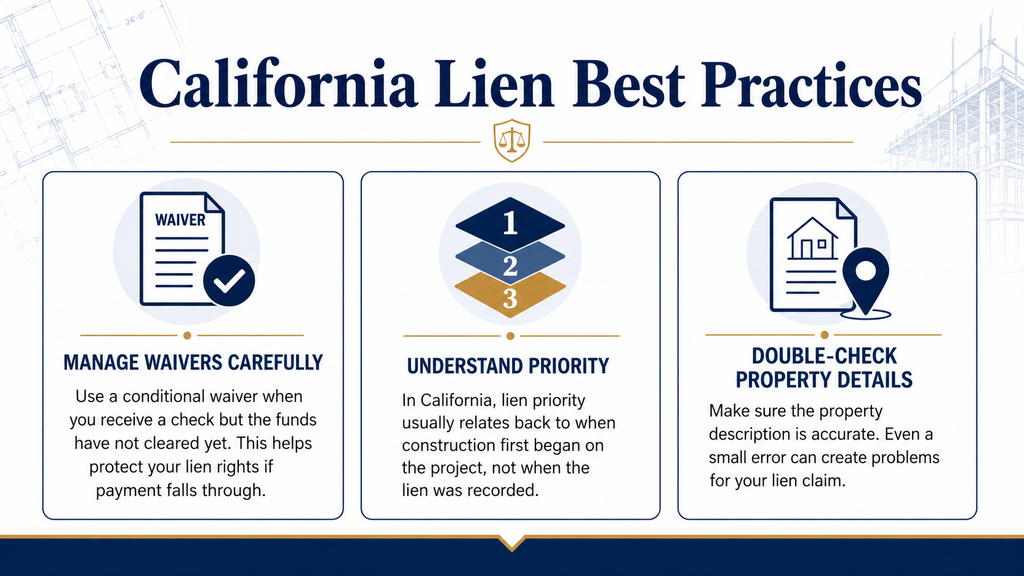
Navigating California Civil Code Section 8000-9566, the body of statutes governing private works of improvement, requires meticulous attention to detail. Here are some actionable tips:
- Manage Waivers Carefully: Property owners often request lien waivers when issuing payments. Always use a Conditional waiver and release on progress payment when you are handed a check but the funds haven’t cleared the bank yet. This protects your rights if the check bounces.
- Understand Priority: The Priority of mechanics liens in California is tied to the date construction first commenced on the project, not the date the lien was recorded. This gives mechanics liens a unique “super priority” over many other types of encumbrances, such as later-recorded mortgages.
- Double-Check Property Details: Ensure the legal description of the property is 100% accurate. A simple typo can invalidate your claim.
Removing an Invalid Mechanics Lien from Property a Property in CA
On the flip side, if you are a property owner facing an improper, exaggerated, or expired lien, you have legal remedies. Removing an invalid mechanics lien from a property typically starts with sending a written demand to the contractor to release the claim. If they refuse, an owner can file a petition in court to expunge the lien. If the court sides with the owner, the contractor may be forced to pay the owner’s attorney fees.
Get Help With Your California Mechanics Liens
California mechanics lien requirements leave little room for error. A missed preliminary notice, inaccurate property detail, or late filing can jeopardize your ability to recover payment, even when the underlying debt is valid.
Lienguard helps contractors, subcontractors, material suppliers, and other construction professionals protect their payment rights without managing every notice, deadline, and filing requirement alone. Our team can assist with California preliminary notices, mechanics liens, stop payment notices, and other construction payment documents, helping you take the right action at the right time.
Do not wait until a deadline is approaching to determine whether your lien rights are protected. Contact Lienguard today to discuss your unpaid project and start the filing process.